Module Cloning
ECU, ECM, PCM, BCM and TCM
When your original module has a hardware fault but its memory can still be read, cloning copies your data onto a part-number-matched donor. The replacement goes in carrying your VIN, your configuration and your security data, so the vehicle accepts it as the module it already knew.
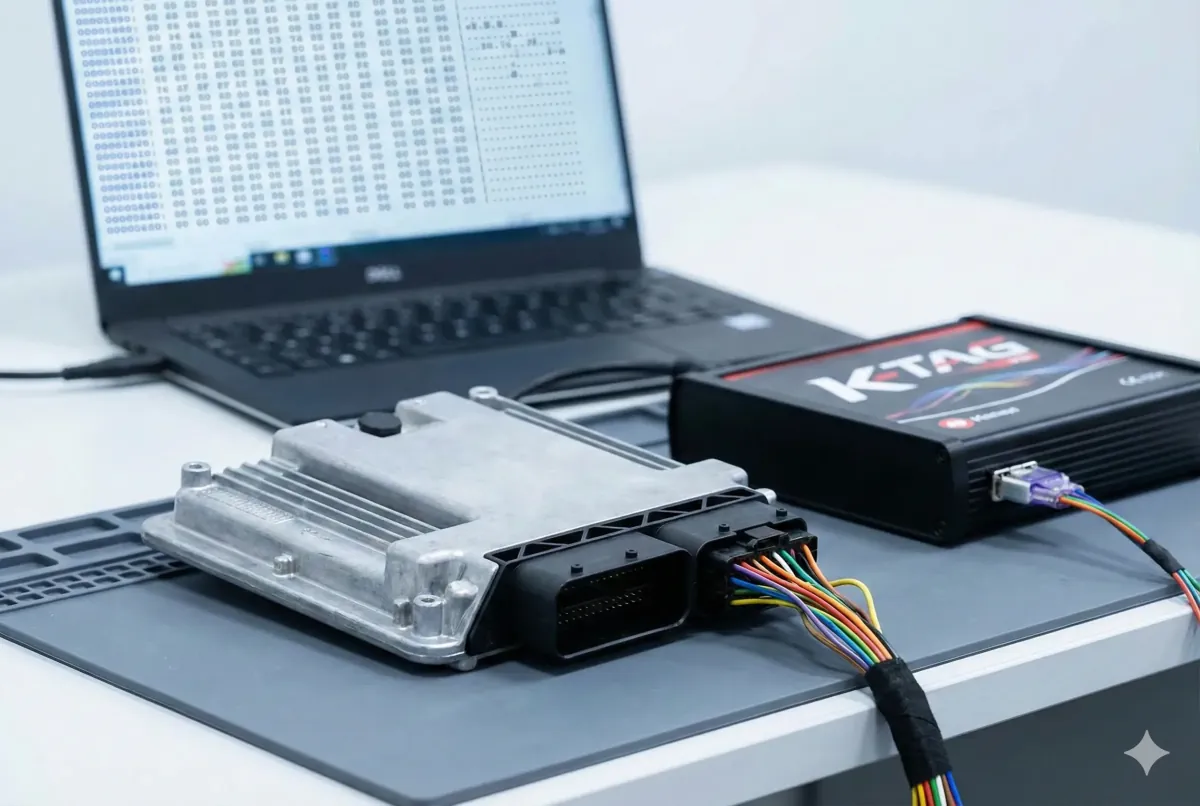
It is usually the cheaper route than programming a replacement from scratch, and it is the only route that preserves data a dealer would otherwise have to rebuild. We do it on-site across metro Atlanta, or on the bench if the module is already out.
How we clone a module
The same six steps every time, whichever module it is.
- 1
Read the original module on the bench
The original is removed and connected on the bench. We read the flash and EEPROM contents directly rather than through the OBD-II port, which works even when the module no longer communicates with the vehicle.
- 2
Confirm the donor is a true hardware match
We compare the full OEM part number and, where the platform requires it, the hardware revision and processor family. A connector that fits is not a match. On GM this means confirming the controller generation across E38, E39, E67, E78, E80, E82, E84, E90 and E92, plus T87 and T87A on the transmission side.
- 3
Transfer VIN, configuration and security data
The VIN, the option configuration (RPO on GM, as-built on Ford) and the theft-deterrent data are written to the donor so the vehicle network accepts it as the original module.
- 4
Install and verify communication
The cloned module goes back in the vehicle and we confirm every module on the network sees it, with a Midtronics PSC-550S or PSC-700S regulated supply holding voltage at 55 A or 70 A throughout.
- 5
Run the relearns the platform requires
Crank and cam relearn, idle and throttle body relearn, transmission adaptives — whichever the specific platform calls for after a module change.
- 6
Pre-scan and post-scan, documented
Codes from every module before and after, handed to you with the VIN and the part numbers on the work order.
When cloning will not work
We would rather tell you on the phone than after you have bought a donor module. Cloning is not the answer when:
- The original module is water-damaged, burnt, or physically broken such that its memory cannot be read.
- The donor is not a true part-number match, or comes from a different hardware revision the platform treats as incompatible.
- The platform uses encrypted or server-locked module architecture that requires an authorized online session.
- The fault is not the module at all — a lost power feed, a corroded ground, damaged CAN wiring or a failed sensor produces the same symptoms.
That last one matters most. Module failure is misdiagnosed often, which is why we run a full diagnostic before recommending any module work. Replacing a module that was never the problem costs you the module and leaves the fault in place.
What we need before we start
- ·Year, make, model, engine and transmission
- ·Full 17-digit VIN
- ·A clear photo of the label on the original module
- ·The part number of the donor, before you buy it
- ·Whether the original still powers up and communicates
- ·The diagnostic codes from every module, not only the engine
Do not buy a donor module before that call. A donor bought on year and model alone is the most common reason a clone fails, and salvage yards rarely take returns.
Related services
Have the part number ready
With the VIN and the module label we can tell you on the first call whether your original is readable and what the donor has to match.
(404) 812-8951What this costs
Module cloning to a matched donor
$250 – $450
Covers the bench read of your original, the transfer of its VIN, configuration and theft-deterrent data to a part-number-matched donor, and verification that the vehicle network accepts it.
Confirmed September 2026 · before travel
Auto Module Programming prices cloning on how the original has to be read. A module that still answers over OBD-II sits at the bottom of the band. One that has stopped answering has to come out and be read directly — boot mode, BDM or JTAG depending on the platform — which is where the hours go. If the memory will not read at all, there is nothing to copy and we quote the programming route instead before going any further.
Read us the part number off the donor before you buy it — a unit that misses on the part number or the hardware revision cannot be used, and that is cheaper to find out now than after the money is spent. Auto Module Programming checks it against your VIN at no charge on (404) 812-8951